

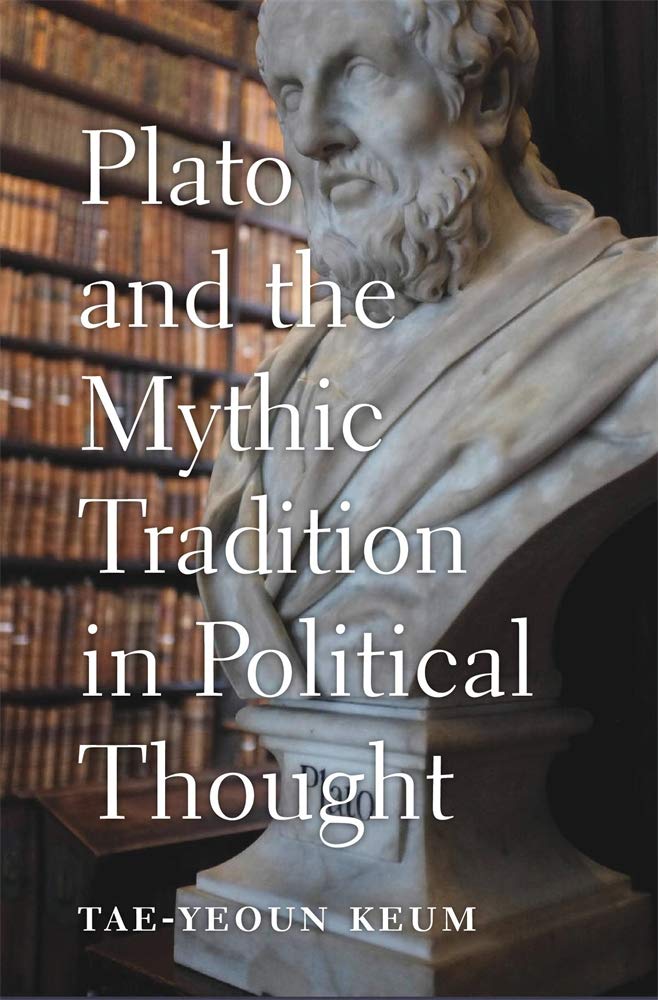
Plato And The Mythic Tradition In Political Thought
Plato And The Mythic Tradition In Political Thought
Author : Keum, Tae-Yeoun
Publisher : Belknap Press
Product Description Winner of the Gustave O. Arlt Award in the HumanitiesWinner of the Istvan Hont Book PrizeAn ambitious reinterpretation and defense of Plato’s basic enterprise and influence, arguing that...
SKU
9780674984646Sub total
Rs. 3,039.00Couldn't load pickup availability
Estimated delivery 5-7 days
People are viewing this right now
Description
Product Description
Winner of the Gustave O. Arlt Award in the HumanitiesWinner of the Istvan Hont Book PrizeAn ambitious reinterpretation and defense of Plato’s basic enterprise and influence, arguing that the power of his myths was central to the founding of philosophical rationalism.Plato’s use of myths?the Myth of Metals, the Myth of Er?sits uneasily with his canonical reputation as the inventor of rational philosophy. Since the Enlightenment, interpreters like Hegel have sought to resolve this tension by treating Plato’s myths as mere regrettable embellishments, irrelevant to his main enterprise. Others, such as Karl Popper, have railed against the deceptive power of myth, concluding that a tradition built on Platonic foundations can be neither rational nor desirable.Tae-Yeoun Keum challenges the premise underlying both of these positions. She argues that myth is neither irrelevant nor inimical to the ideal of rational progress. She tracks the influence of Plato’s dialogues through the early modern period and on to the twentieth century, showing how pivotal figures in the history of political thought?More, Bacon, Leibniz, the German Idealists, Cassirer, and others?have been inspired by Plato’s mythmaking. She finds that Plato’s followers perennially raised the possibility that there is a vital role for myth in rational political thinking.
Review
Well suited to the moment. The convergence of pandemic conspiracy theories with populist narratives of globalist malfeasance shows that the desire for stories that give meaning to our collective experience is alive and kicking (if not exactly well)…Keum’s study is an exercise in demystification, showing the Platonist approach to myth to be more complex?and relevant?than we thought…Subtle and enriching. -- Knox Peden ?
Australian Book Review
Keum establishes both that narrative myth is a persistent tool for political theorists in modernity and antiquity, and that its use has given rise to continuing debates on the proper content and form of political theorizing. Those debates have sharpened as the dangers and power of political myth have become more apparent, but as she ably shows, the ambiguous role of myth in political theorizing has a long history and is inescapably bound into the texture of the canon of Western political thought. -- Carol Atack ?
Bryn Mawr Classical Review
Tak[es] up in a refreshingly original way the problem of political myth…[Keum’s] subtle and careful text suggests that myth and work on myth are both the cause of and the possible solution to the polarization of political life as it manifests itself in, and depends upon, culture. -- Isaac Ariail Reed ?
Hedgehog Review
A splendid achievement. -- Teresa Bejan ?
Mind
The breadth of Keum’s erudition with regard to the history of philosophy is impressive, as is the depth of her knowledge of the texts and thinkers treated throughout. -- Joseph Forte ?
Review of Metaphysics
Plato and the Mythic Tradition in Political Thought provides a fine, original, and persuasive case for a reconsideration of Plato’s myths and their bearing on political thought. Tae-Yeoun Keum’s reading of Plato as a political philosopher who sees the value of myth-making deserves a wide audience. -- Tushar Irani, author of
Plato on the Value of Philosophy
Tae-Yeoun Keum traces a rich tradition reflecting on Plato’s use of myth, revealing how attention to myth as a literary artifact can modulate its relationship to unchallenged social verities and serve in philosophical self-examination and social improvement. Her readings of More, Bacon, Leibniz, the German Idealists, and Cassirer are subtle and original in drawing out these themes. -- Melissa Lane, Princeton University
An important book for our troubled times. Beginning with Plato and extending into Plato’s reception amongst modern theorists of myth, Keum’s guiding question is whether myth, in its ability to captivate the mind in what might be described as a non-ration