

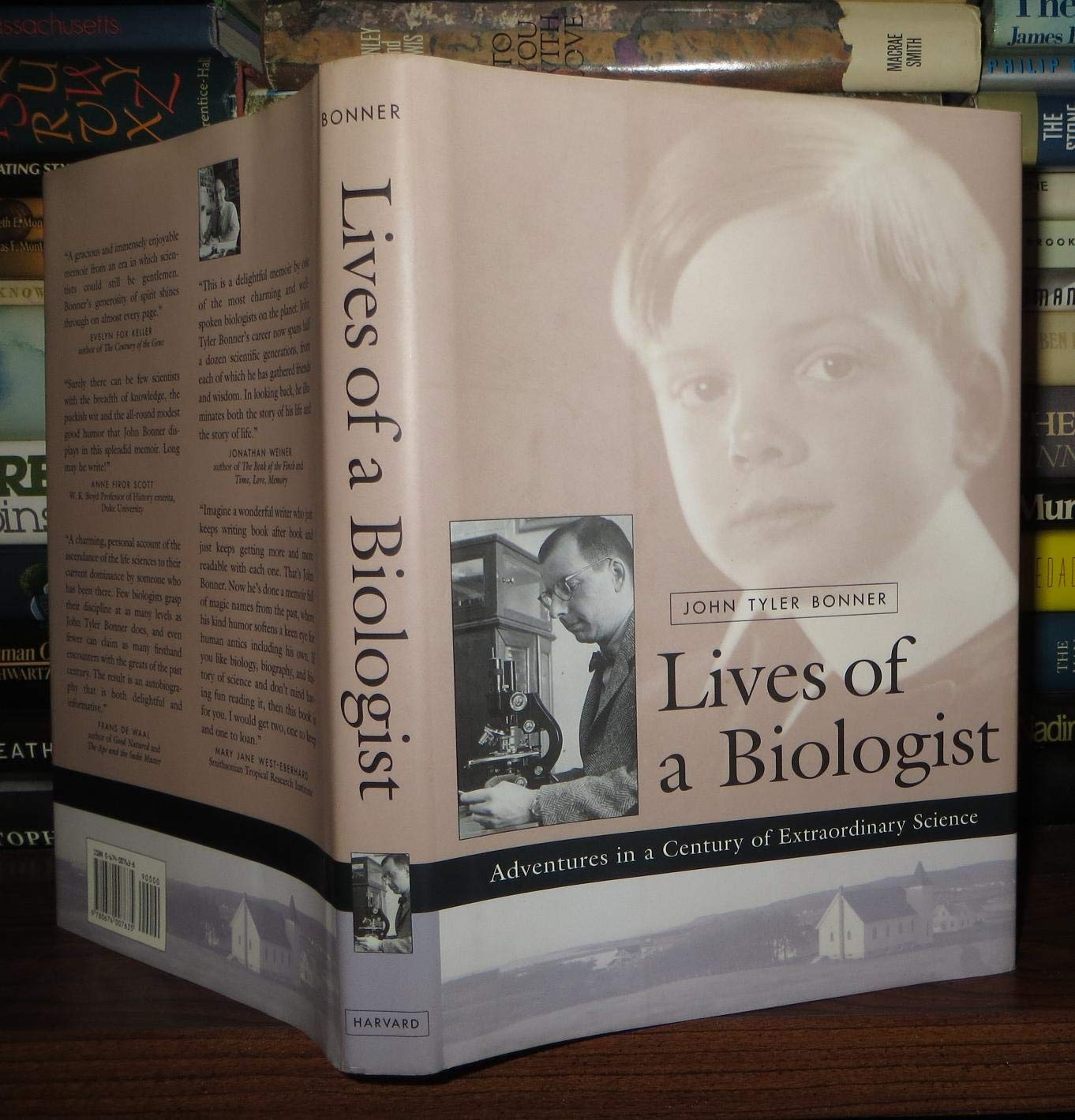
Lives Of A Biologist
Lives Of A Biologist
Author : Bonner, John Tyler
Publisher : Harvard Univ Press
Product Description Beginning with the discovery of genes on chromosomes and culminating with the unmasking of the most minute genetic mysteries, the twentieth century saw astounding and unprecedented progress in...
SKU
9780674007635Sub total
Rs. 3,919.00Couldn't load pickup availability
Estimated delivery 5-7 days
People are viewing this right now
Description
Product Description
Beginning with the discovery of genes on chromosomes and culminating with the unmasking of the most minute genetic mysteries, the twentieth century saw astounding and unprecedented progress in the science of biology. In an illustrious career that spanned most of the century, biologist John Bonner witnessed many of these advances firsthand. Part autobiography, part history of the extraordinary transformation of biology in his time, Bonner’s book is truly a life in science, the story of what it is to be a biologist observing the unfolding of the intricacies of life itself.Bonner’s scientific interests are nearly as varied as the concerns of biology, ranging from animal culture to evolution, from life cycles to the development of slime molds. And the extraordinary cast of characters he introduces is equally diverse, among them Julian Huxley, J. B. S. Haldane, Leon Trotsky, and Evelyn Waugh. Writing with a charm and freshness that bring the most subtle nuances of science to life, he pursues these interests through the hundred years that gave us the discovery of embryonic induction; the interpretation of evolution in terms of changes in gene frequency in a population; growth in understanding of the biochemistry of the cell; the beginning of molecular genetics; remarkable insights into animal behavior; the emergence of sociobiology; and the simplification of ecological and evolutionary principles by means of mathematical models. In this panoramic view, we see both the sweep of world events and scientific progress and the animating details, the personal observations and experiences, of a career conducted in their midst.In Bonner’s view, biology is essentially the study of life cycles. His book, marking the cycles of a life in biology, is a fitting reflection of this study, with its infinite, and infinitesimal, permutations.
From Booklist
At 13, Bonner was already an avid bird-watcher who divided his spare time between looking for birds in the parks of London, to which his family had lately moved from New York, and studying the bird gallery at the Natural History Museum. Fearing that his son was narrowing his prospects, Bonner's father gave him a copy of H. G. Wells, Julian Huxley, and G. P. Wells' popular
The Science of Life--a gift that opened the youngster's eyes completely. Now 81, Bonner has devoted much of his imaginative and creative biological research of the intervening years to cellular slime molds, which lead fascinating and, before Bonner's work, previously largely unexplained lives. His accounts of his and his graduate students' thinking and experiments convey much of the scientific approach to problems lucidly, and those of his travels, his vacations in Nova Scotia over the course of 40 years, and the many amusing and illuminating incidents in his life reflect a refreshing open-mindedness. This is one scientist's autobiography that manages to be simultaneously delightful and strikingly informative.
William Beatty
Copyright © American Library Association. All rights reserved
Review
Here is a man of prodigious scientific talent, who emerges in
Lives of a Biologist as the best kind of scientist?a man fascinated by the things he is investigating, and finding great joy in them… This is a life well and fulfillingly lived, told with warmth and humor. -- John R. G. Turner ?
New York Times Book Review
John Tyler Bonner had the luck to be born into a family that lived a charmed life, the fortune to find a lifelong passion and the timing to live at the heyday of his favorite subject. In his autobiography,
Lives of a Biologist: Adventures in a Century of Extraordinary Science, Bonner…smoothly integrates advances in biology during the 20th century with tales from a life that now stretches into its ninth decade. In simple but elegant prose, he revisits some of the most important biological advances, from embryology to molecular genetics. -- Sally Squires ?
Washington Post
This memoir by the great cele